Sevilla
La piel del tamborSevilla is both the material setting of the novel’s conflicts and a measure of what outlasts them. Its church, aristocratic houses, exhibition rooms, streets, and riverbank hold the action in specific places, while the city’s accumulated history gives those places meanings beyond any single scheme or character. The threatened Nuestra Señora de las Lágrimas stands at the center of a struggle over power and preservation; in the final movement, Lorenzo Quart walks back to it through the night, and the old city receives his private crisis into a history that continues beyond individual lives.
The City’s Inherited Layers
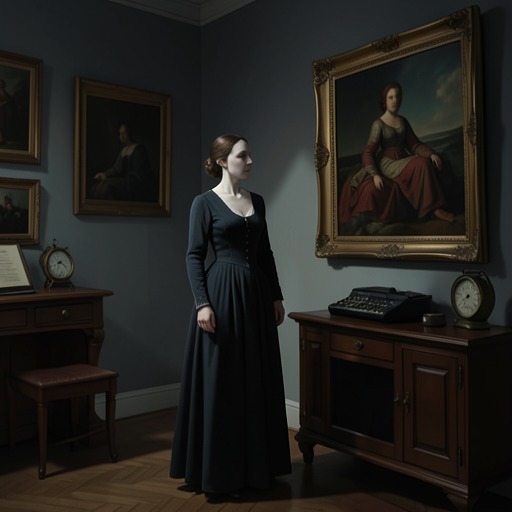
Sevilla appears as a city where the past is not remote scenery but part of daily movement. At a dinner in the Bruner household, Lorenzo Quart crosses from the summer dining room into a patio surrounded by portraits of ancestors in white ruffs and dark clothing. Cruz Bruner identifies them through their old offices: an admiral of the Ocean Sea, a general, a governor of the Netherlands, and a viceroy of the West Indies. The family’s inherited status is made tangible in the house itself, from the marble busts brought centuries earlier from the ruins of Itálica to the mosaic underfoot and the Mudéjar ceiling above the portraits. Quart’s shadow passes beside the Duchess’s as Macarena Bruner follows them carrying a cushion for her mother.
The same history appears in the damaged church rather than in a preserved aristocratic interior. Nuestra Señora de las Lágrimas contains dusty votive offerings, a natural-haired figure of the Nazarene, gilded altarpiece carving, and praying statues of the Dukes of the New Extremity. Restoration scaffolding cuts across the old sacred space. The church is not simply a monument viewed from outside: it is a working and contested place, at once devotional inheritance and threatened property. Its persistence connects the city’s religious memory to the present-day struggle over whether it will survive.
Streets, Houses, and Private Histories
The city’s domestic and public spaces shape how its people encounter one another. During the art exhibition, Pencho Gavira moves through the gathering with practiced ease, greeting guests and making his way toward Archbishop Corvo and Octavio Machuca. He is conscious of the whispers behind him about Macarena, yet keeps his smile composed. In the exhibition hall, the familiar Sevillian painting In Ictu Oculi gives this social scene a stark counter-image: Death extinguishes a candle while a coffin, a sword, books, and worldly emblems lie beneath it. Gavira does not know the Latin, but understands the image’s plain warning that death can strike in the blink of an eye.
At the Bruner house, the city opens out from the dovecote into a night view of Santa Cruz. The rooftops seem arranged like an old theatrical set, broken by a lit window, a distant streetlamp, or washing hanging like shrouds from a terrace. The Giralda shines against the darkness, while the church’s bell gable appears almost within reach beyond the moving white curtains. Macarena says the night breeze comes from the sea, rising from Sanlúcar. The view joins her immediate surroundings to a larger geography: the city is enclosed by its old streets, but its air and outlook remain open to the coast.
The church also becomes the site of a new death. When another misfortune is reported, Nuestra Señora de las Lágrimas fills with uniformed and plainclothes police, who photograph the scene and search the floors, pews, and scaffolding. Gris Marsala sits alone on the altar steps as Simeón Navajo meets Quart in the nave. Later, Bonafé’s body is brought out from the confessional and placed in a metallic plastic bag on a stretcher. The police investigation occupies the same worn sacred interior that elsewhere carries the church’s devotional and family history: in Sevilla, the old setting does not shield its inhabitants from violence.
The Guadalquivir and the City’s Wider Scale
The riverfront provides a different stage for the novel’s precarious alliances. At night, Quart and Macarena wait beside a locked gate near the Arenal, with the illuminated dome of the Maestranza theatre and an angle of Banco Cartujano visible beyond the palms and bougainvillea. Farther downriver, the Tower of Gold stands by San Telmo Bridge; between these landmarks lies the Canela Fina, dark and apparently lifeless at its mooring. Macarena watches for the man sent by Gavira and fears that something has gone wrong. The stillness of the boat makes the promised rescue uncertain, while the visible landmarks place the private danger inside the city’s recognizable river landscape.
After the night’s events, Sevilla’s enduring life is expressed through ordinary possibilities rather than triumph. Don Ibrahim, the Potro, and Niña Puñales are safe, though Ibrahim has lost the possessions and imagined fortune he left aboard the Canela Fina. The river, Triana’s lights, the statue of Juan Belmonte, the bars of the Altozano, and the prospect of Curro Romero at La Maestranza return the scene to the city’s continuing rhythms. Human losses and schemes matter intensely to those involved, yet the city is imagined as remaining in place, scented with orange blossom, bitter oranges, night-blooming jasmine, and spring jasmine, reflecting in the river through which so many lives and dreams have passed.
Quart’s Walk Back to the Church
Near the end, Quart leaves the church after receiving absolution from its elderly parish priest. He crosses a deserted square and heads toward San Telmo Bridge, declining a free taxi because he needs to walk. The route leads him past the darkened Moorish tower, across the bridge, by the Alfonso XIII Hotel and the walls of the Royal Alcázar, then through the narrow streets of Santa Cruz. Municipal street cleaners work in the Patio de Banderas; beyond it, orange trees and damp earth accompany his passage through the old quarter. The sequence turns a walk across familiar urban ground into an interval outside ordinary time.
The walk brings Quart to a small square with Quixote scenes on tiled benches, geraniums, and houses painted in red earth and white lime. At its far end stands Nuestra Señora de las Lágrimas, its deteriorated bell gable propped by scaffolding and its headless Virgin barely visible in her niche. Quart sits on a bench and watches the church through the remaining hours of night. The clock’s strokes repeatedly startle pigeons and swifts from the eaves; cold tightens as dawn approaches. Slowly the eastern light outlines the gable, roof, and square until the first day’s colors settle over the walls. Quart then rises and walks toward the church as if returning from a long sleep.
Continuity and Human Scale
The final scene gives Sevilla a significance larger than its role as backdrop. The church is old not only in years but in the accumulated memory of the people who have sheltered beneath its roof, and it remains physically damaged and threatened even as the morning light makes its outline newly distinct. The ending does not resolve that tension by making the city’s inheritance invulnerable. Instead, it places Quart’s changed relation to the church within a city whose streets, river, birds, and daily renewal persist around private grief and uncertain outcomes.
Sevilla’s recurring contrast is between what human beings build or inherit and what time takes from them. The aristocratic portraits, sacred carvings, and church scaffolding register histories still visible but not secure; In Ictu Oculi makes mortality explicit; the river carries the image of lives and dreams arriving and departing. Against that transience, the city’s continuity offers neither a guarantee of justice nor a simple consolation. It supplies a durable place in which loss can be remembered, and to which a solitary figure can return at dawn.